7 picks · vetted plastic-free
The best plastic-free espresso machines
Lever machines that take their water from a kettle and push it through stainless steel, plus the one pump machine we would put on a counter.
An espresso machine holds water at 90 degrees and above for as long as it is switched on, and in most home machines that water sits in a plastic reservoir and travels through plastic lines before it reaches the boiler. Researchers have measured that heating water in contact with plastic drives particle release sharply upward, so a machine that stays warm all day is the wrong place for a plastic tank.
The way around it is to stop storing water in the machine at all. A lever machine takes a single shot's worth of water from a kettle and pushes it through a stainless cylinder with your arm, so there is no tank to store it in. The one pump machine here has a metal boiler and a metal group, and its removable reservoir is the only plastic the water touches.


Robot Barista Manual Lever Espresso Maker


The kettle that feeds a lever
Every lever machine on this page wants water just off the boil, and the kettle you use is part of the brew path. Both Fellow kettles are stainless where the water sits, and the gooseneck spout on the Stagg makes filling a narrow brew cylinder tidy.


Common questions
- Do espresso machines have plastic in them?
- Almost all of them. The reservoir on a typical home machine is plastic, and the tubing that carries water to the boiler often is too. The boiler and group on a well-built machine are brass or stainless, which is where the water is hottest, so that is the part to check first.
- Which espresso machine has no plastic water tank?
- Lever machines like the Flair and the Cafelat Robot have no tank at all: you pour hot water from a kettle straight into a stainless cylinder for each shot. Among pump machines, a metal reservoir is rare on anything built for a home counter, so the practical choice is a machine whose boiler and group are metal and whose plastic is limited to the removable tank.
- Is a moka pot real espresso?
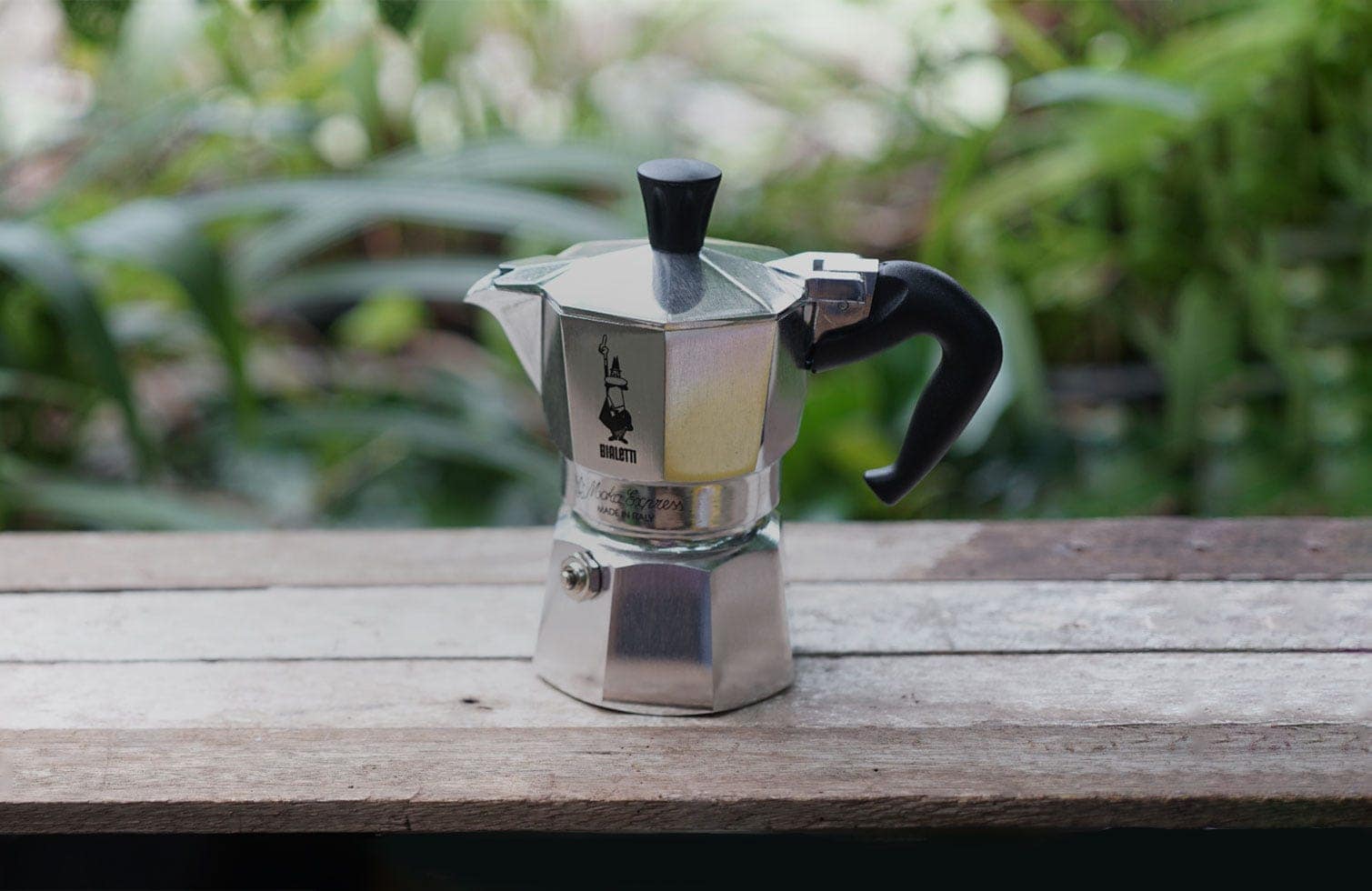
- Close, and the same idea. Steam pressure in a moka pot reaches around 1.5 bar, where an espresso machine works at 9. You get a strong, concentrated cup with less crema, from an aluminum or stainless pot that costs about the same as a couple of bags of beans.
- Are lever espresso machines hard to use?
- There is a learning curve of a few days. You preheat the cylinder with hot water, then pull the lever with steady pressure for about thirty seconds. The Cafelat Robot Barista and the Flair 58 both carry a pressure gauge, which takes the guesswork out of how hard to pull.
Sources
- Drinking Boiled Tap Water Reduces Human Intake of Nano- and Microplastics · Environmental Science & Technology Letters (ACS) (2024)
- Plastic Teabags Release Billions of Microparticles and Nanoparticles into Tea · Environmental Science & Technology (ACS) (2019)
- Microplastics Are Everywhere. Here's How to Avoid Eating Them. · NYT Wirecutter (2024)